

Ben Roberts-Smith: The Inconvenient Soldier
- Johnny Chal
- Apr 8
- 8 min read
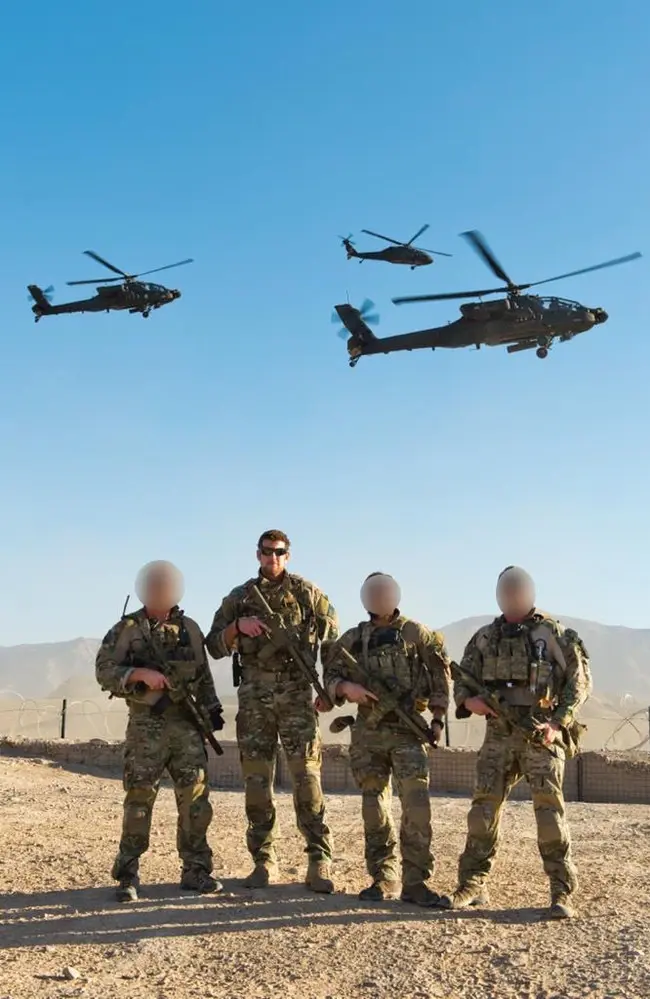
On Tuesday morning, Australian Federal Police were waiting at the arrivals gate as a flight from Brisbane landed at Sydney Airport.
Among the passengers was Ben Roberts-Smith: Victoria Cross recipient, Medal for Gallantry holder, the most decorated living soldier Australia has ever produced.
They arrested him in front of his twin fifteen-year-old daughters.
Let that image sit with you for a moment.
This is the same man who, on 11 June 2010, demonstrated extreme devotion to duty and the most conspicuous gallantry in action, with total disregard for his own safety, storming an elevated Taliban fortification containing three enemy machine gun positions and superior numbers of heavily armed insurgents. He drew enemy fire to protect his pinned-down patrol members, then stormed and silenced two machine-gun positions at close range. This is the stuff of Hollywood. And this really happend.
The Governor-General of Australia pinned the Victoria Cross to his chest. The Queen received him at Buckingham Palace. His combat uniform hangs in the Australian War Memorial. He was named Australian Father of the Year.
Now he faces five counts of war crime murder, and a possible life sentence.
I was there
I spent a substantial part of 2011 in the Middle East. The bulk of my time was spent in Kabul, Kandahar, and Jalalabad. Afghanistan wasn't theory for me. It wasn't something I had read about in reports or watched debated on the news. It was real, immediate, and unpredictable, and believe me, you did not always know who the enemy was. That wasn't a rare anomaly. That was the operating environment.
I rarely speak about what I saw. I rarely discuss this specific day. But this moment demands it.
I remember the day our convoy was hit. I think about it most days.
A young Afghan kid was standing by the side of the road with a football. In any other country, in any other life, that image means nothing. Just a child, just a game.
But in Afghanistan, nothing is just what it looks like. You learn that fast, or you don't last long.
The ball rolled toward the lead vehicle.
In that fraction of a second, your brain runs every possibility at once. Is it a ball? Is it a bomb? Is this child a child, or is he a weapon someone else loaded and aimed?
You have half a second to decide. There is no committee. There is no protocol that covers this exact moment. There is only you, your training, and the men in that lead vehicle.
The IED detonated. The lead vehicle took the full force of the blast.
Whatever decisions were made in the smoke and chaos that followed were made by human beings running on adrenaline, instinct, and the desperate need to protect the person next to them.
Not policy. Not hindsight. Not the careful reasoning of a judge in a quiet room years later.
We acted. And then we had to live with it forever.
That is the reality no inquiry has ever adequately put on the record.
What is justice?
Upon arrival at the compound on my first day on the ground, we were briefed on the rules of engagement. They mattered. They were part of what defined us, we were there to assist, to stabilise, and to hold a line between order and chaos.
There was meant to be a clear line between us and groups like the Taliban, who operated by no comparable standard. That distinction wasn't incidental. It was everything.
This was a UN-mandated, NATO-led coalition that at its peak comprised more than 130,000 personnel from 51 nations. This was not a rogue operation. It wasn't a unilateral adventure. It was one of the most scrutinised, multilaterally governed military missions in modern history, operating under strict rules of engagement with legal and government affairs teams embedded at multiple levels of command, precisely to ensure compliance with laws.
Troops from Australia, the UK, New Zealand, and the United States operated side by side. Professional soldiers from some of the most accountable military institutions in the world, all operating under the same framework, all facing the same impossible environment.
I was part of the legal affairs structure within that mission, there to understand the rules, apply them, and advise on them. So when I speak about the gap between what happens on the ground and how it is later assessed in a courtroom, I am not speaking as an outsider. I am speaking as someone who understood the framework, its constraints, and its very real human limitations.
I understand accountability. I believe in it. But there is a profound difference between accountability and the retrospective dismantling of a man's life using frameworks that never existed in the environment where the decisions were made.
As William Tecumseh Sherman said: "War is hell." Not metaphorically. Architecturally. It is built on incomplete information, exhaustion, fractured communication, and decisions that must be made in seconds, decisions that will then be forensically dissected across months or years by people with something no soldier in combat ever had: time.
What the inquiry missed
The Brereton Report, released in 2020, found evidence that elite Australian SAS and commando regiment troops unlawfully killed 39 Afghan prisoners, farmers, and other noncombatants. Those findings cannot simply be dismissed. Accountability matters. Innocent people died, and that is a serious thing to sit with.
But accountability without context isn't justice.
It's something else wearing justice's clothes.
Because here is what the reports don't adequately capture: the speed, the chaos, the fog, the pressure, the near-impossibility of distinguishing combatant from civilian in the kind of asymmetric warfare that defined Afghanistan. These were not conventional battlefields. There were no uniforms on the other side. There were no front lines. There were villages where one man might be a farmer by day and a Taliban operative by night. You made decisions in that world in seconds. The inquiry made its findings across years.
And there is another dimension that receives almost no serious scrutiny: the reliability of the witness testimony on which these findings rest.
Local testimony from environments like Afghanistan is not inherently dishonest, but it is inherently complicated. In regions marked by extreme poverty, tribal pressure, and active insurgent influence, statements can be shaped by money, fear, self-preservation, or the logic of local power dynamics. When witnesses are potentially receiving significant financial compensation, or are navigating pressures that we, sitting in comfortable Australian courtrooms, cannot begin to adequately imagine, the picture becomes considerably less clean than the legal narrative suggests.
That is not a claim that nothing happened.
It is a claim that building a definitive criminal case, years later, in a different country, in a different moral universe, on the basis of such accounts is far more complex than the public has been led to believe.
Matthew 7:1 says simply: "Do not judge, or you too will be judged. For in the same way you judge others, you will be judged, and with the measure you use, it will be measured to you."
That is not a call to moral relativism. It is a call to epistemic humility, to recognise the limits of our own vantage point before we render verdicts on others who stood in places we have never stood.
The Australian double standard
People are complicated:
A man can be genuinely heroic and still make a terrible decision under impossible pressure.
A man can do good things and wrong things, sometimes in the same moment, under the same sky.
That is the nature of human beings in extremity. It is not a comfortable truth, but it is the actual truth.
What troubles me most, though, is not just the legal case. It is the moral inconsistency at the heart of how Australia is conducting itself.
But the inconsistency doesn't end with the evidence. It runs all the way to the border.
Following the terrorist attack at Bondi Beach in December 2025, allegedly carried out by a father and son inspired by the Islamic State group, the Australian Government announced new powers for the Home Affairs Minister to cancel or reject visas for those who spread hate and division. This came after years of documented failures, years in which people with known links to extremist ideologies were permitted to enter and remain in Australia. Australian Federal Police Commissioner Krissy Barrett confirmed that her agency already had ongoing investigations into people described as hate preachers operating on Australian soil.
Read that again.
Australia has been permitting known hate preachers to operate within its borders. It has watched, with documented awareness, as individuals with extremist sympathies moved through its immigration system. It has spent years unable or unwilling to confront that problem with the same ferocity it has now directed at one of its own decorated soldiers.
The Office of the Special Investigator spent over $300 million across more than ten years to bring this case to the point of charges. Three hundred million dollars. A decade. To arrest a man at an airport in front of his daughters.
Meanwhile, the people his unit was sent to fight, or ideological successors to them, were walking through Australian immigration while our government looked the other way.
This is not a defence of wrongdoing, if wrongdoing occurred. It is a demand for proportionality. For consistency. For a government willing to apply the same ferocity to the threats it has permitted through the front door as it is now directing at the man it sent through the back door of a war zone in Kandahar Province.
What this country owes
Ben Roberts-Smith was widely regarded as one of Australia's most admired soldiers before these allegations emerged, named Australian Father of the Year, appointed Chair of the National Australia Day Council, and recognised as a national hero.
That record does not make him immune from accountability. But it does demand that he be treated as something more than a symbol of institutional guilt, a sacrifice offered up to demonstrate that Australia takes war crimes seriously, while remaining conspicuously less serious about the threats it has actively enabled at home.
A man was arrested in front of his children.
A man who ran toward enemy fire when his mates were pinned down.
A man whose courage this country once celebrated as the best of what it could produce.
Whatever the truth of Afghanistan, and I suspect the truth is more complicated than either his defenders or prosecutors want to acknowledge, Australia owes it to itself to be honest about what it is doing here, and why, and whether the standards it is applying have been consistently applied to everyone who has posed a threat to this nation's security.
Because if they haven’t, and the evidence suggests they have not, then this isn't justice.
It's performative.
Coda
I will say this plainly:
Everyone I know who has served, locally or overseas, in recent times or decades past, appear to agree with this sentiment.
Not because they are covering for each other.
Not because they don't believe in accountability.
But because they have stood in versions of that moment, and they know what it costs, and they know what it means to have people who were never there sit in judgment of the seconds that defined it.
That shared understanding doesn't make the front pages.
But it is real, it is widespread, and it deserves to sit at the centre of this conversation, not as a footnote, but as the truth that every courtroom should be required to reckon with before it renders its verdict.


Comments